Addressing the Growing Complexity of Wildfire Emergencies
Climate change is driving a new generation of wildfires that are more frequent, larger, more intense, and increasingly simultaneous. These events threaten lives, critical infrastructure, and natural ecosystems while making emergency response significantly more complex.
Today, the challenge is no longer simply to deploy more firefighting resources. Emergency teams must make life-critical decisions within minutes, often with incomplete or fragmented information. Success depends on providing decision-makers with accurate, real-time intelligence that enables faster and more informed actions.
Technology is Transforming Wildfire Response
Modern wildfire management relies on advanced digital technologies to improve detection, prediction, and emergency coordination.
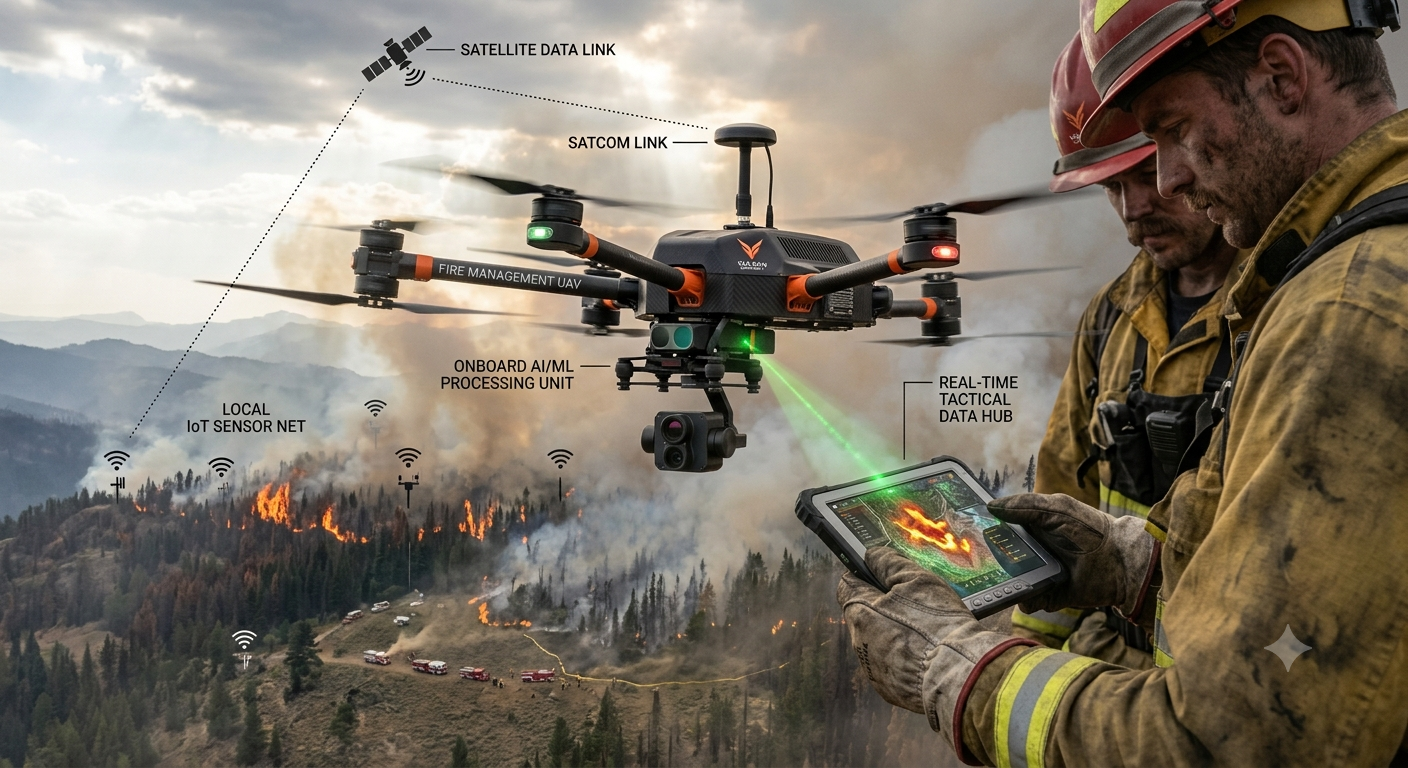
Artificial Intelligence, Earth Observation, drones, IoT sensors, robotics, and advanced communication systems provide continuous situational awareness by:
- Detecting fires at their earliest stages
- Predicting fire behavior using weather, terrain, and vegetation data
- Monitoring inaccessible areas safely
- Supporting real-time operational decisions
- Improving coordination between emergency teams
- Increasing responder safety while reducing environmental and economic impact
The Power of Earth Observation on intelligent satellites
Earth Observation (EO) is a key enabler of modern wildfire management. Thermal, optical, and SAR satellite imagery enables the early detection of hotspots and smoke, while continuous monitoring supports fire spread prediction, risk assessment, and optimized resource deployment.
EO also plays a vital role in wildfire prevention by monitoring vegetation health, fuel moisture, and drought conditions. After a fire, satellite imagery provides rapid damage assessment and supports ecosystem recovery and restoration planning.
Conventional EO satellites transmit all collected data to ground stations for analysis, a process that can take hours or even days depending on communication windows and data volume. These delays can significantly reduce the effectiveness of early wildfire detection.
By processing data directly onboard the satellite, AI can detect potential wildfires in real time and transmit only the relevant alerts and coordinates. This enables ground operators to notify emergency services within seconds, dramatically accelerating response times while reducing communication bandwidth.
Edge AI as aid for Wildfire Management
Wildfires often occur in remote areas where cloud connectivity is unreliable, slow, or unavailable. Edge AI enables data to be processed directly where it is generated—on satellites, drones, smart cameras, and sensor nodes—reducing dependence on cloud infrastructure while delivering real-time insights.
Low-power edge devices equipped with smoke, thermal, or environmental sensors can continuously monitor wildfire-prone areas and transmit only relevant events instead of raw data. Since wireless communication consumes significantly more energy than local AI processing, this approach extends battery life, reduces bandwidth requirements, and enables faster detection.
Real-time intelligence at the edge allows emergency services to detect wildfires earlier, respond more quickly, and make better-informed operational decisions.
Klepsydra: Real-Time Edge AI for Wildfire Management
Klepsydra provides a high-performance software platform for executing AI algorithms in real time on resource-constrained edge devices. Whether deployed onboard satellites, drones, or embedded microprocessors, Klepsydra accelerates data processing and AI inference while ensuring deterministic performance, functional safety, and cybersecurity.
Designed for mission-critical applications, Klepsydra enables faster, more efficient AI execution at the edge, allowing organizations to make real-time decisions where speed, reliability, and resilience matter most.
Real-Time AI for Earth Observation Satellites
Deploy state-of-the-art AI models directly onboard Earth Observation satellites to detect wildfires using optical, thermal, or SAR imagery. Generate real-time alerts while significantly reducing communication bandwidth.
Edge AI for Drones and Smart Cameras
Run AI models and data compression algorithms directly on drones, thermal cameras, and embedded vision systems, enabling reliable real-time operation even in areas with limited or no cloud connectivity.
Autonomous Drone Fleet Coordination
Develop intelligent applications that coordinate multiple autonomous drones to maximize area coverage, optimize mission planning, and enhance real-time situational awareness through Klepsydra’s high-performance data processing platform.
Multi-Sensor Data Fusion
Fuse data from Earth Observation satellites, drones, infrared cameras, LiDAR, weather services, and ground sensors into a single operational picture. AI-powered sensor fusion provides more accurate fire detection, improved risk assessment, and better-informed decision-making.
Conclusion
By combining intelligent Earth Observation, Edge AI, and real-time data processing, Klepsydra empowers firefighters and civil protection authorities with the actionable insights needed to detect wildfires earlier, predict fire behaviour, prioritize interventions, and deploy resources more effectively.
From satellites in orbit to sensors, drones, and edge devices on the ground, Klepsydra delivers real-time intelligence where every second counts—helping protect lives, critical infrastructure, and natural ecosystems.
Benefits
- Earlier wildfire detection through real-time AI at the edge
- Faster emergency response with instant alerts and actionable intelligence
- Enhanced situational awareness from multi-source data fusion
- More accurate fire behaviour prediction for informed decision-making
- Optimized deployment of personnel and resources
- Reliable operation in remote and disconnected environments
Why Klepsydra?
Klepsydra enables emergency organizations to shift from reactive wildfire response to proactive, AI-driven wildfire management. By delivering real-time intelligence from satellites, drones, sensors, and edge devices, Klepsydra helps emergency teams make faster decisions, improve operational efficiency, and respond with greater confidence.
Klepsydra Edge AI delivers the intelligent platform needed to protect people, infrastructure, and ecosystems against the growing threat of wildfires.