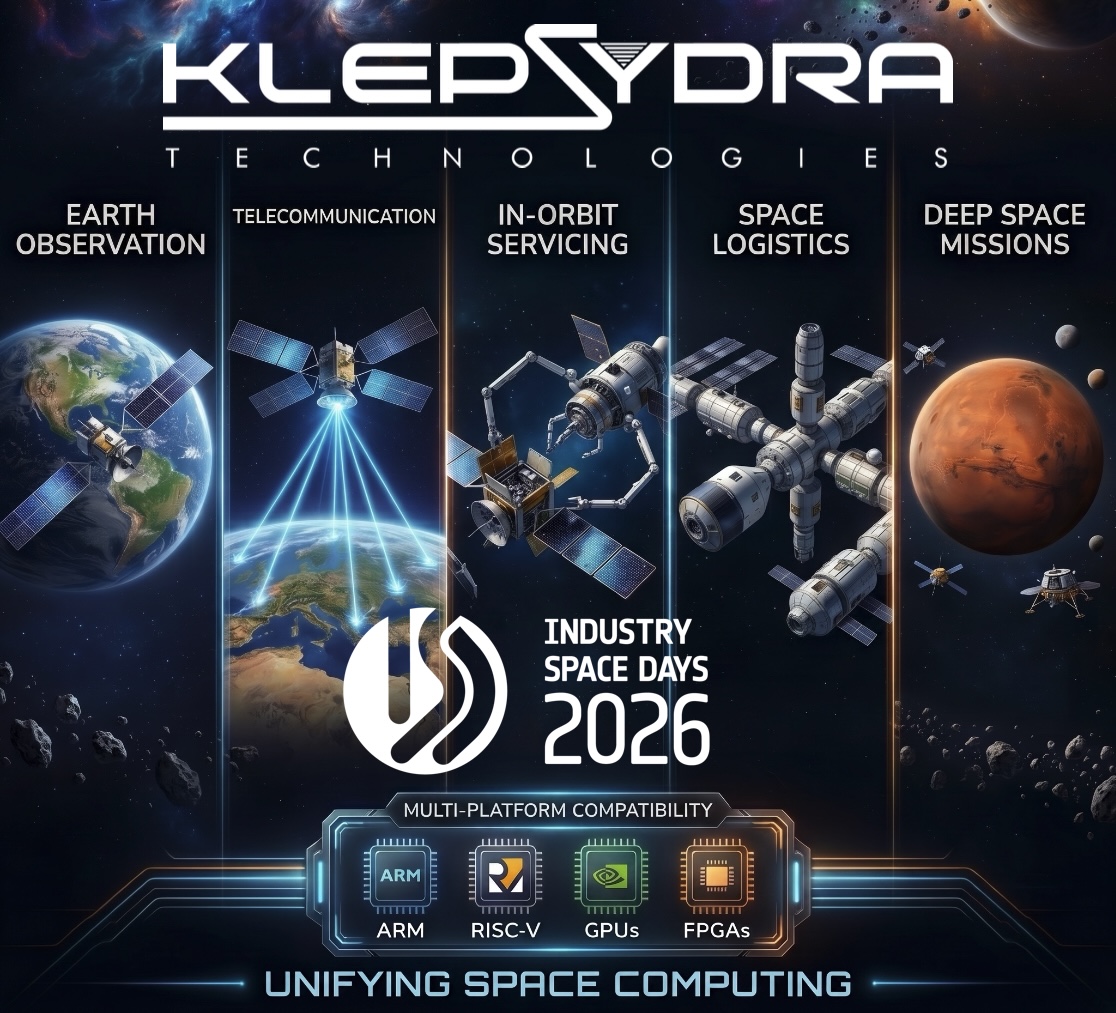
Klepsydra Technologies will be at ISD!
We’re excited to be back at ISD this year, bringing new demonstrations and showcasing the latest developments from Klepsydra Technologies.
This year, we’re particularly pleased to present new demos developed jointly with our growing network of partners (see below), highlighting how our technology can be integrated into broader space and edge computing ecosystems and address real-world mission requirements.
We’ll also be showcasing our latest product developments, including support for an expanding range of space and edge computing platforms, giving mission developers more flexibility when selecting the hardware and architectures best suited to their applications.
A major highlight this year is Klepsydra AI, our flagship AI inference engine, which is now space pre-qualified. This is a significant milestone for us and, to our knowledge, makes Klepsydra AI the only AI inference engine on the market to have achieved space pre-qualification. This opens up new possibilities for deploying AI directly onboard spacecraft and other resource-constrained edge platforms, enabling intelligent data processing closer to where data is generated.
We’d be very happy to discuss your onboard data processing and AI requirements, whether you are working on a new mission, evaluating different computing architectures, or looking at ways to process and analyse more data directly onboard.
If you’re attending ISD, feel free to book a meeting with us. We’d love to meet, show you our latest demos, and explore how Klepsydra could support your next mission.
See you at ISD!
Save the date
When: September 16 – 17, 2026
Klepsydra Booth C52
Our partners at ESA ISD

Signal Processing Demo
Powered by Klepsydra AI on an AMD Kria board, our solution converts complex RF environments into time-frequency spectrograms, using the ultra-lightweight YOLOv8 Nano model (~6 MB) to instantly detect, localize, and classify Wi-Fi, Bluetooth, and 5G signals—including collisions—with ultra-low latency at the edge.

Teledyne e2v Demo
Klepsydra Technologies and Teledyne e2v have paired Klepsydra AI with the LX2160 space processor to run multiple containerized AI models concurrently on a single satellite platform. This high-performance hardware-software solution accelerates onboard Earth observation processing and enables Satellite-as-a-Service resource sharing while drastically cutting downlink bandwidth.

Microchip Demo
Deployed on the Microchip PolarFire for maximum performance, this end-to-end pipeline uses a VGG22 deep learning model to detect lunar craters and analyze crater density for safe landing site selection. Powered by Klepsydra AI, the solution offers ultimate deployment flexibility, seamlessly scaling to run on alternative platforms such as the Gaisler NOEL-V.

Ideas-TEK demo
Optimized with the Klepsydra GPU connector on an IdeasTek onboard computer, this Earth Observation pipeline uses an ESA OBPMark-ML AI algorithm to black out cloud pixels before compression, significantly reducing file sizes to save bandwidth while preserving critical data.

BrainChip Demo
BrainChip and Klepsydra’s partnership was announced last March at Embedded World. This partnership has now produced its first results with this space navigation demo, which combines Klepsydra AI software with BrainChip’s Akida accelerator. The resulting solution is not only extremely fast, but also remarkably easy to use.
Lothan Space Demo
Klepsydra and Lothan have partnered to showcase a joint lunar landing demo running on the space-grade LX2160 processor. Powered by a 1.93M parameter U-Net architecture, this high-performance engine processes 360×640 FPV rover feeds to deliver real-time, 8-class hazard mapping. Designed with a safety-first priority chain, strict operator constraints for microsecond accuracy, and color-blind accessible high-contrast visuals, it guarantees reliable, flight-ready hazard avoidance for critical space operations.

Draper Demo
Deployed on the Microchip PolarFire for maximum performance, this end-to-end pipeline uses a YOLOv8 deep learning model to detect lunar craters and analyze crater density for safe landing site selection. Powered by Klepsydra AI, the solution offers ultimate deployment flexibility, seamlessly scaling to run on alternative platforms such as the LX2160 or NVIDIA Jetson Orin
SARMAP Demo
Developed in partnership with SARMAP, this demo features an advanced AI model engineered to detect and classify different vessel types directly from Synthetic Aperture Radar (SAR) imagery. Powered by Klepsydra AI, the pipeline highlights exceptional performance flexibility across downstream systems—seamlessly deploying from low-power edge hardware like the Raspberry Pi 5 to high-performance platforms like the NVIDIA Jetson Orin NX while maximizing speed, low latency, and operational efficiency.